Sports Info Solutions decided to make the 2020 Fielding Bible Awards a global affair this year. Today we announce the winners of the inaugural NPB and KBO Fielding Bible Awards for defensive excellence.
The awards were voted on by panels of experts and Sports Info Solutions Video Scouts who spent the entire season tracking NPB and KBO games. Among the members of the expert panels were ESPN’s Karl Ravech and newspaper reporters Jeeho Yoo (Yonhap News Agency, South Korea), and Kaz Nagatsuka (Japan Times). A full list of the voting panels can be found at the end of the article.
Each voter ranked their top four players at each position in the league they covered, with 4 points awarded for a first-place vote, 3 for second and so forth. The panel also voted on a multi-position award given to a player who played less than 70% of his innings at any one position. Eligibility for voting was based on playing-time requirements.
NPB Fielding Bible Award Winners
Position
Name
Team
C
Takuya Kai
Fukuoka SoftBank Hawks
1B
Hiroyuki Nakajima
Yomiuri Giants
2B
Ryosuke Kikuchi
Hiroshima Toyo Carp
3B
Nobuhiro Matsuda
Fukuoka SoftBank Hawks
SS
Hayato Sakamoto
Yomiuri Giants
LF
Norichika Aoki
Tokyo Yakult Swallows
CF
Koji Chikamoto
Hanshin Tigers
RF
Taishi Ohta
Hokkaido Nippon-Ham Fighters
P
Masato Morishita
Hiroshima Toyo Carp
Multi-Position
Ukyo Shuto
Fukuoka SoftBank Hawks
The league champion Fukuoka SoftBank Hawks had three of the award winners – catcher Takuya Kai, third baseman Nobuhiro Matsuda and multi-position standout Ukyo Shuto. Matsuda, who tied for the third base lead in Defensive Runs Saved, is the standout of the group. He has a streak of seven straight Mitsui Golden Gloves (the NPB’s Gold Glove honor) as well.
The team the Hawks beat in the Japan Series, the Yomiuri Giants, were represented in the Fielding Bible Awards by first baseman Hiroyuki Nakajima and shortstop Hayato Sakamoto.
Another standout from this group is Hiroshima Toyo Carp second baseman Ryosuke Kikuchi. He finished second at the position in Defensive Runs Saved in 2020 but is the runaway leader at second base dating back to 2018.
One former major leaguer won a Fielding Bible Award, Yakult Swallows left fielder Norichika Aoki. Aoki played six seasons in MLB, most recently in 2017 when he split time between the Astros, Blue Jays, and Mets.
KBO Fielding Bible Awards, 2020
Position
Name
Team
C
Eui-ji Yang
NC Dinos
1B
Jin-sung Kang
NC Dinos
2B
Hye-sung Kim
Kiwoom Heroes
3B
Kyoung-min Hur
Doosan Bears
SS
Dixon Machado
Lotte Giants
LF
Yong-ho Jo
KT Wiz
CF
Hae-min Park
Samsung Lions
RF
Kun-woo Park
Doosan Bears
P
Eric Jokisch
Kiwoom Heroes
Multi-Position
Hye-sung Kim
Kiwoom Heroes
The KBO champion NC Dinos and runner-up DooSan Bears each had two winners of the KBO Fielding Bible Awards. Catcher Eui-ji Yang and first baseman Jin-sung Kang won for the Dinos. Third baseman Kyoung-min Hur and right fielder Kun-woo Park won for the Bears.
Kiwoom Heroes second baseman Hye-Sung Kim gets a special tip of the cap for winning the Fielding Bible Award at both second base and for multi-position excellence. He split time during the season between second base, shortstop, and left field and led all second basemen in Defensive Runs Saved.
Kim’s teammate, pitcher Eric Jokisch, was one of two ex-major leaguers to win a KBO Award. He joined Lotte Giants shortstop Dixon Machado. Jokisch pitched only four games for the Cubs in 2014 but has been one of the KBO’s top pitchers since coming to South Korea at the start of the 2019 season. Machado, who previously spent parts of four seasons with the Tigers, stood out defensively for the Lotte Giants with his 30 Good Fielding Plays (as tracked by SIS Video Scouts), the most of anyone at his position.
“We are very excited that the Fielding Bible Awards have gone global,” said Sports Info Solutions owner John Dewan. “Great defensive play is a part of winning baseball at every level and you can see that in how the top teams in the NPB and KBO are represented in these awards. Congratulations to all the winners.”
Fielding Bible Award voters:
NPB: Jim Allen (JballAllen.com), Dan Casey (SIS Senior Operations Analyst/MLB Coordinator), Jason Coskrey (Japan Times), John Gibson (Japan Baseball Weekly Podcast), Kaz Nagatsuka (Japan Times), SIS Video Scouts.
KBO: Ted Baarda (SIS operations analyst), Dan Kurtz (MyKBOStats.com), Hoonki Min (SPOTV), Karl Ravech (ESPN), Jordan Shusterman (Céspedes Family BBQ), Jeeho Yoo (Yonhap News), SIS Video Scouts.
Baseball Prospectus’ 2006 collection of staff essays, Baseball Between the Numbers, includes a piece by Dayn Perry titled, “When Does a Pitcher Earn an Earned Run?” In it, Perry writes that, because of the subjective scoring of errors by a stadium’s official scorer, ERA doesn’t fully do what it’s meant to do, isolate a pitchers’ performance from his defense.
Perry’s essay sparked inspiration when I read it. I wanted to create a new stat to try to more fairly assign the debit for runs given up. What follows is something I put together as my own creation, with Sports Info Solutions assisting by providing data.
Earned Run Average is simply that, an average. The actual number of ‘runs’ multiplied doesn’t *need* to be a whole number, because the result itself won’t be.
Obviously, when a player hits a (non-inside-the-park) home run, yes, the fault is 100% on the pitcher. However, within a game, many runs that are scored are both the fault of the pitcher and the defense behind him.
In addition, when runners that are inherited by one reliever score, those runs are charged to the pitcher who bequeathed them. Since those runs are the faults of two separate pitchers, both pitchers should be debited.
At Sports Info Solutions, our system of Defensive Misplays is subjective, but still stretches far beyond the binary limitations of hits and errors. When a team puts up a crooked number capitalizing on an ‘error’ by the other team, the pitcher is freed of “earned runs,” but not when there’s a borderline hit or error that was ruled a hit. That pitcher gets charged a full earned run, even though it was partially his defense’s fault.
On the flipside, if a team commits an error with two outs, and then, say, six more batters come up, the official scorer may not call any of those runs earned. Even though after that crucial error, those subsequent baserunner advances weren’t the defense’s fault.
This is where my concept, which I’m calling Split Runs, comes in.
Split Runs asks this question: What if, since a runner who scores advances four total bases, the allowance of a run was looked at in one-quarter intervals? With the assistance of the SIS R&D staff, we were able to nail down a stat that takes every base, not run, taken by every runner who eventually scored, and assign it to the pitcher who was on the mound for that runner’s at bat. Then we count the number of bases that any Defensive Misplay accounted for and subtract that from the four bases he actually traveled. Finally, we add up the number of base advancements attributable to the pitcher, except in cases where there was enough offensive action afterward that he would have scored anyway.
You can still refer to a reliever’s Inherited Runners Scored, but Split Runs applies the context of each base-state situation they entered in. Normally, if pitcher A is taken out with bases loaded, and pitcher B enters and gives up a grand slam, pitcher A would have three earned runs, and pitcher B would be charged with one. With Split Runs, now pitcher A is instead charged with 1.5 runs and pitcher B is debited 2.5 runs, as the runner who was on third advanced 1 base (0.25 runs), the runner on second advanced 2 bases (0.5 runs), and the runner on first advanced 3 bases (0.75 runs).
Below are the Top 30 Starting Pitchers in spRA, and the Top 30 in ERA from 2020, minimum 40 Innings:
Pitcher
spRA
Pitcher
ERA
1
Shane Bieber
1.69
1
Shane Bieber
1.63
2
Yu Darvish
1.92
2
Trevor Bauer
1.73
3
Zach Plesac
1.95
3
Dallas Keuchel
1.99
4
Trevor Bauer
1.97
4
Yu Darvish
2.01
5
Dallas Keuchel
1.99
5
Dinelson Lamet
2.09
6
Dinelson Lamet
2.09
6
Corbin Burnes
2.11
7
Corbin Burnes
2.11
7
Clayton Kershaw
2.16
8
Max Fried
2.13
8
Max Fried
2.25
9
Brad Keller
2.18
9
Zach Plesac
2.28
10
Tony Gonsolin
2.22
10
Chris Bassitt
2.29
11
Jacob deGrom
2.42
11
Tony Gonsolin
2.31
12
Kenta Maeda
2.46
12
Jacob deGrom
2.38
13
Chris Bassitt
2.46
13
Brad Keller
2.47
14
Clayton Kershaw
2.51
14
Dustin May
2.57
15
Hyun-Jin Ryu
2.59
15
Hyun-Jin Ryu
2.69
16
Kyle Hendricks
2.66
16
Kenta Maeda
2.70
17
Carlos Carrasco
2.68
17
Taijuan Walker
2.70
18
Dustin May
2.69
18
Zach Davies
2.73
19
Zac Gallen
2.78
19
Zac Gallen
2.75
20
Mike Clevinger
2.97
20
Gerrit Cole
2.84
21
Gerrit Cole
3.02
21
Kyle Hendricks
2.88
22
Justus Sheffield
3.05
22
Carlos Carrasco
2.91
23
Blake Snell
3.06
23
Zack Wheeler
2.92
24
Zack Wheeler
3.07
24
Sandy Alcantara
3.00
25
Brandon Woodruff
3.08
25
Mike Clevinger
3.02
26
Zach Davies
3.08
26
Brandon Woodruff
3.05
27
Julio Urias
3.15
27
Marco Gonzales
3.10
28
Steven Brault
3.16
28
Adam Wainwright
3.15
29
Antonio Senzatela
3.19
29
Luis Castillo
3.21
30
Marco Gonzales
3.20
30
Blake Snell
3.24
To better apply the defensive aspect, I’ll draw from one inning from this season that may have helped swing the NL Cy Young Award towards eventual winner Trevor Bauer.
On September 4, against the Pirates, the fourth inning began with an error by Joey Votto. Later, two runs scored on a triple by Anthony Alford. On that triple, Brian Goodwin had a Defensive Misplay (DM) for Slipping. Another run scored on a wild pitch, and the inning ended with the Pirates plating three runs, all unearned runs for Bauer.
By Split Runs, the defense was only responsible for .75 out of the three runs—0.25 for the one-base error by Votto, and 0.5 from the DM by Goodwin, whose misplay turned a double into a triple, thus allowing a runner on first to score when he might’ve held on third. That means Bauer would be charged 2.25 Split Runs.
Bauer finished with a 1.73 ERA, but his spRA was 1.97 over his 73-inning season. Yu Darvish wound up finishing with a lower spRA, 1.92, than his ERA, 2.01, over 76 innings, making this year’s Cy Young race closer than many thought.`
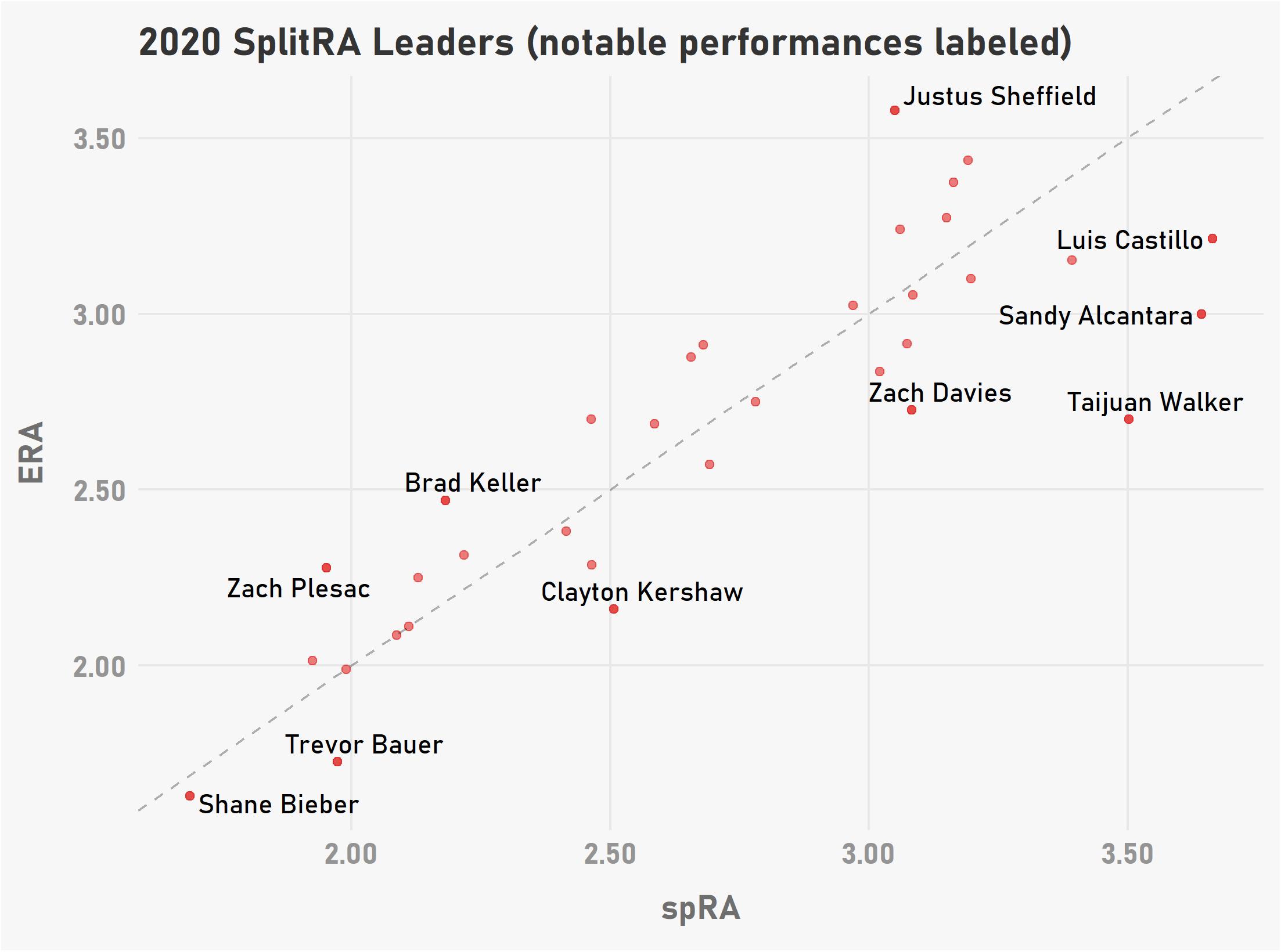
And here’s each Starter in the Top 30 of either ERA or spRA:
You can see a strong positive correlation, with Pearson’s coefficient for the correlation between spRA and ERA being .95.
However, there are plenty of pitchers with enough of a difference that make this measure of run prevention well worth tabulating and exploring.
The biggest outlier here is Justus Sheffield, who ranked 44th among qualifiers in ERA at 3.58, but 22nd in spRA at 3.05. Sheffield left seven runners on base in the 2020 season, and his relievers let six of those runners score. Those six earned runs equated to 2.75 Split Runs.
Here’s the leaderboard for Relievers in 2020:
Pitcher
spRA
Pitcher
ERA
1
Erasmo Ramirez
0.63
1
Jacob Webb
0.00
2
Alex Colome
0.71
2
Devin Williams
0.33
3
Jake Diekman
0.74
3
Jake Diekman
0.42
4
Jesse Hahn
0.78
4
Jarlin Garcia
0.49
5
Devin Williams
0.83
5
Jesse Hahn
0.52
6
Nick Anderson
0.96
6
Nick Anderson
0.55
7
Yimi Garcia
1.05
7
Yimi Garcia
0.60
8
Kyle Zimmer
1.08
8
Erasmo Ramirez
0.63
9
Codi Heuer
1.24
9
Alex Colome
0.81
10
Matt Wisler
1.24
10
A.J. Minter
0.83
11
Jacob Webb
1.35
11
Adam Kolarek
0.95
12
A.J. Minter
1.35
12
Chris Martin
1.00
13
Chris Martin
1.38
13
Matt Wisler
1.07
14
Trevor Rosenthal
1.52
14
Darren O’Day
1.10
15
Jordan Romano
1.53
15
Nick Tropeano
1.15
16
Cesar Valdez
1.57
16
Jordan Romano
1.23
17
T.J. Zeuch
1.59
17
James Hoyt
1.23
18
Liam Hendriks
1.60
18
Cesar Valdez
1.26
19
Victor Gonzalez
1.66
19
Tanner Scott
1.31
20
Cam Bedrosian
1.69
20
Victor Gonzalez
1.33
21
Riley Smith
1.72
21
Drew Pomeranz
1.45
22
Brad Hand
1.74
22
Riley Smith
1.47
23
Joely Rodriguez
1.78
23
Rafael Dolis
1.50
24
Drew Pomeranz
1.81
24
Codi Heuer
1.52
25
Jeremy Jeffress
1.83
25
Jeremy Jeffress
1.54
26
Jarlin Garcia
1.84
26
Eric Yardley
1.54
27
Kyle Cody
1.89
27
Kyle Zimmer
1.57
28
Andre Scrubb
1.90
28
Kyle Cody
1.59
29
Bryan Garcia
1.97
29
T.J. Zeuch
1.59
30
Caleb Thielbar
2.03
30
Bryan Garcia
1.66
Hansel Robles had a disastrous 10.26 ERA in 2020, but he did have a… less disastrous 7.29 spRA. Robles was hurt by how earned runs were charged. He was removed with the bases loaded twice in situations in which all three runners scored. Meanwhile, Blake Parker was the biggest beneficiary of classic Earned Runs among relievers, as his very good 2.81 ERA in 2020 doesn’t fall in line with his poor 5.06 spRA. Parker let five inherited runners score out of 14, including two from first base.
Every time there’s a Defensive Misplay leading to a run, the defense is charged a portion of a Split Run. Here are the 30 teams in terms of BIS’ flagship stat, Defensive Runs Saved, against Team Split Runs in 2020:
Team
Split Runs
Team
DRS
1
Dodgers
9.75
1
Cardinals
33
2
Athletics
10.75
2
Dodgers
29
3
Twins
12.5
3
Indians
27
4
Brewers
12.5
4
Pirates
26
5
Indians
13
5
Rays
24
6
Reds
14
6
Cubs
23
7
Tigers
14.25
7
White Sox
23
8
Cubs
14.5
8
Twins
22
9
Royals
14.5
9
Mariners
17
10
Astros
15.5
10
Rockies
15
11
Nationals
15.5
11
Astros
12
12
Cardinals
15.75
12
Rangers
11
13
Rays
16.25
13
Reds
6
14
Rangers
17
14
Giants
6
15
Pirates
17.25
15
Padres
3
16
Diamondbacks
18
16
Marlins
0
17
Angels
18
17
Orioles
-1
18
Red Sox
18.25
18
Yankees
-1
19
White Sox
19.25
19
Diamondbacks
-2
20
Marlins
19.75
20
Red Sox
-2
21
Orioles
20.25
21
Braves
-8
22
Blue Jays
20.25
22
Royals
-10
23
Padres
21.25
23
Brewers
-14
24
Braves
22.75
24
Tigers
-14
25
Mets
23.25
25
Athletics
-19
26
Yankees
23.5
26
Mets
-22
27
Phillies
23.5
27
Angels
-26
28
Mariners
24.75
28
Phillies
-33
29
Rockies
27
29
Blue Jays
-39
30
Giants
29.25
30
Nationals
-43
The World Series Champion Dodgers had the fewest Split Runs against them in the league, falling in line with their No. 2 overall ranking in Defensive Runs Saved. You can see that the Giants were middle of the pack in Team DRS but their misplays cost their pitchers the most total Split Runs, at 29.25.
It’s one thing to have a collective defense consistently make good plays at the right time; it’s another to prevent mistakes from happening at the most crucial times, and mistakes that could swing a game towards the other team.
If a pitcher has a higher spRA than ERA, then at least a portion of unearned runs were partially his fault. If a Pitcher has a higher ERA than spRA, then their defense made a few misplays behind him that weren’t called errors, and/or relievers came in and were unable to put out that pitcher’s fire, causing the pitcher’s ERA to go up, possibly unfairly.
I believe Split Runs works because it gets closer to a proper measurement of damage the pitcher allowed. There is some room for improvement (i.e. potentially adding in Good Fielding Plays to mirror how the system handles Defensive Misplays) but even just the splitting of responsibility between pitcher, defense, and subsequent relievers is a strong start.
As the Korean Series is under way and their off-season around the corner, now is a good time to look at some players who could make the jump to MLB. Today we will look at three outfielders who had big seasons in Korea and could draw MLB interest in the coming weeks.
Mel Rojas Jr.
Mel Rojas Jr. had a breakout season in 2020, narrowly missing out on a Triple Crown and leading his team, KT Wiz, to its first playoff appearance. Rojas led all KBO hitters with 47 HR and 135 RBI (9 HR and 11 RBI ahead of the next closest players). He finished third in batting average at .349, 5 points back of league leader Hyung-woo Choi.
Season
AVG
OPS
HR
BB%
K%
2017
.301
.911
18
6.3
22.1
2018
.305
.978
43
11.0
22.0
2019
.322
.911
24
8.5
20.8
2020
.349
1.097
47
10.4
21.0
Rojas Jr. has turned himself into the best hitter in the KBO. In addition to his traditional stats he has also ranked at the top of our leaderboard for Hard Hit Rate throughout the year.
A rare switch hitter in the KBO, Rojas uses a leg kick timing mechanism to start his swing, and has quick hands and a level swing that allows him to square the ball up. He is also able to cover the entire strike zone, slashing liners on pitches up, and going down to elevate pitches at the bottom of the zone.
Rojas does have some swing and miss in his approach, likely because he is selling out for hard contact. This works in the KBO as most pitchers don’t feature elite velocity or wipeout breaking pitches. In an appearance on the SIS Baseball Podcast when asked about facing nasty sliders in the KBO, Rojas Jr. responded, “Nasty sliders? [There are] not very many, but they do have some nasty forkballs here.”
In MLB Rojas Jr. may need to adjust his approach to counter the higher velocity and better breaking balls that he will face.
Defensively Rojas Jr. can cover center field in a pinch, although he is probably more of a corner outfielder at this point. In 2019 he dealt with an ankle injury, which he talked about in that podcast interview, which limited his range and ability to field balls. Since the beginning of 2019 Rojas Jr. has moved from playing primarily center, to more time in the corners and at DH for the Wiz. As a former center fielder Rojas Jr. has good instincts in the outfield, can track balls well, and has a good arm.
Rojas Jr. does not rate exceptionally in baserunning. Despite having decent speed before his ankle injury, he never developed good base-stealing instincts. In his KBO career Rojas Jr. has gone 27-for-53 in stolen base attempts, and largely stopped attempting steals in 2020, with just one unsuccessful attempt. In MLB, against catchers with quicker releases and stronger arms, I would guess Rojas Jr. won’t be doing any basestealing, though his speed is still fine and he will not be a base-clogger when he gets on.
Overall, Rojas Jr. projects as a starting-caliber corner outfielder, along the lines of a Lourdes Gurriel Jr., though Rojas Jr. is a switch hitter. Similar to Gurriel Jr., Rojas Jr.’s success will likely be reliant on his batted balls finding holes and dropping in for hits, and on his ability to control his strikeout rate. These characteristics may end up making Rojas Jr. a streaky hitter.
I believe that the 30-year-old Rojas Jr. should be able to contribute to a MLB team for the next few seasons but he will need to find an organization that believes in him and is willing to give him a chance, a la what the Giants did with then 28-year-old Mike Yastrzemski in 2019.
Sung-bum Na
Sung-bum Na is a power hitting right fielder and DH for the NC Dinos who is coming off a career year with a personal-best 34 HR, which is even more impressive when you consider his background. Early in 2019 Na suffered a severe knee injury. which required him to be removed from the field in an ambulance, undergo surgery, and miss the remainder of the year rehabbing.
Season
GP
AVG
OPS
HR
BB%
K%
2017
125
.347
.999
24
8.6
20.7
2018
144
.318
.899
23
7.1
21.1
2019
23
.366
1.088
4
11.3
24.5
2020
130
.324
.986
34
8.4
25.3
Na sets up with a slightly open stance and uses a leg kick to square himself up to the pitcher and start his swing. He follows through with a vicious uppercut swing that enables him to elevate the ball no matter where it is pitched. Na’s best tool is his power, but he also has consistently hit as a pro, with batting averages well north of .300 in every year since his rookie season.
Offensively Na looks like he hasn’t missed a beat since returning, although defensively he was limited to more DH appearances than in previous years. In 2019 he played all of his games in the field, with 18 starts in center and 5 in right. In 2020 he played in the field in only 50 of his 130 games. While he may be playing it safe since suffering the injury, Na’s speed and athleticism has also been limited since returning. His plus defensive attribute is his arm, as Na was a pitcher through his collegiate days before converting to a full-time position player as a pro. Defensively he is a corner outfielder/DH with below-average range and a good arm at this point.
The knee injury also robbed Na of his speed on the bases. While he was never a burner on the bases, he attempted 24 steals in 2017 and 17 in 2018. In 2020 he only attempted 4 steals which again suggests a loss of speed and there was a visible difference in how he ran early in 2019 versus in 2020.
Overall Na is likely a platoon corner outfielder/DH, though given his knee issues a team may try to play him at first base too if they need him to play in the field. Na could be compared to his former teammate with the Dinos, Eric Thames, as a lefty platoon bat who can line up in the corners.
Preston Tucker
Preston Tucker was a 7th round draft pick by the Houston Astros in the 2012 MLB Draft. Coming from a SEC school (Florida), where the competition level is the best in all of NCAA baseball, Tucker was able to quickly climb through the minor leagues and reached AAA less than two years after his professional debut.
Tucker made his MLB debut in 2015 and put together an encouraging season, hitting .243/.297/.437 in 323 plate appearances for the Astros. His 2016 MLB cameo was less fruitful and he took a step back in Triple-A in 2017. By 2018 Tucker was bouncing around the league, and losing playing time between transactions and stints on the bench. During the 2019 season he was released by the White Sox in order to be able to sign with the Kia Tigers, where he has played the last two seasons in the KBO.
Season
Level
PA
AVG
OPS
HR
BB%
K%
ISO
2018
AAA
71
.246
.601
0
2.8
9.9
.087
2018
MLB
184
.229
.703
6
7.1
23.4
.175
2019
AAA
93
.277
.754
1
9.7
7.5
.133
2019
KBO
399
.311
.860
9
9.5
11.0
.168
2020
KBO
631
.306
.955
32
12.0
10.6
.251
The lefty-swinging Tucker sets up with a slightly open and crouched stance. He uses a small leg kick to start his swing and he follows through with a slight uppercut. When he is going well, Tucker slaps line drives from gap to gap and can pull fly balls to right, up and out of the park.
The biggest unknowns about Tucker are if the power jump he showed in the KBO this season is sustainable, and if he can adjust to big league velocity and breaking balls. Playing in the KBO has likely given him plenty of exposure to good off-speed pitches, but the fastballs and breaking balls in MLB are of a higher quality.
On defense, Tucker still has some room for improvement. He looks stiff patrolling the outfield and does not have great speed to track down balls, and defensive metrics were not fans of his work in the Majors. His good arm allows him to play right field in Korea, though it would play closer to average in MLB. On the bases Tucker is not much of a threat to impact a game, as his lack of speed limits his ability to steal bases (0-for-2 in the KBO) or take extra bases regularly.
Tucker made some really good strides this season, but teams may want to see another year of success before they buy into his abilities. The traditional backup outfielder usually has to be able to cover center field, which Tucker can’t do. If you buy into Tucker’s power spike this year then he is a bat-first left fielder, though he could also play right field and potentially first base.
If the power shown this year does not return then Tucker is a backup corner player without power, which is not a common profile in the Majors. A team in need of outfield depth could pick up Tucker for an everyday role, though he could also return to Korea again to further cement himself as a legitimate power hitter.
On this episode of the Sports Info Solutions Baseball Podcast, we begin by discussing the historic hiring of Kim Ng as the Marlins GM with Josh Rawitch (@joshrawitch), the Diamondbacks senior VP of content and communications. Josh and Kim worked together when both were with the Dodgers, and Kim gave Josh a shout-out at her press conference. Josh shares stories about working with her and describes the traits that he thinks will make her a great general manager, including her knowledge base and demeanor (1:47). We’ll be talking more about Kim and women in baseball in greater depth later this offseason.
We are also joined by Jomboy Media baseball analyst, Trevor Plouffe (@trevorplouffe), who played third base for nine MLB seasons (2010 to 2018) (9:59). Trevor helps us preview the free agent market. He gives insights on what it’s like to hit against Trevor Bauer and offers a thought on why Bauer’s success could have staying power (14:31). He also evaluates George Springer, J.T. Realmuto, DJ LeMahieu, and Marcell Ozuna (17:59), along with the crowded market for No. 3 starting pitchers and closers (32:51). Along the way, he discusses things to keep in mind, like which hitters bring value for their long at-bats and which teammates work with players to make them better.
Lastly, we ask Trevor about what it’s like to be a first-round pick and about the challenges that come with being in that spot (36:09).
Thank you for listening. Please rate and review us if you can. Stay safe and stay well.
2020 has been an interesting year for many reasons, and the sports world has been affected as well. MLB’s reported revenue losses have made headlines as this season comes to a close but MLB is not the only baseball league dealing with financial issues.
Japan’s NPB is playing close to a full season, with teams playing 120-game schedules instead of 143 and with some playoff rounds removed, while South Korea’s KBO is playing their full 144 game season with full playoffs.
However, these leagues have played their seasons with limited attendance for most of the season so they are likely also feeling financial losses. One way for these teams to recoup some of their losses is to post their better players and receive a fee from the MLB team that signs that player.
Some teams never post their players, like the SoftBank Hawks, and others like the Yomiuri Giants are new to posting players The Nippon-Ham Fighters are one of the more well-known teams when it comes to posting players. In the past decade two of the most well-regarded Japanese players have come from the Fighters: Yu Darvish and Shohei Ohtani. This year’s Nippon-Ham team does not have that star power, but the Fighters could post some of their current stars this off-season.
LF/DH Kensuke Kondoh
Season
AVG
OBP
SLG
HR
BB%
K%
2018
.323
.427
.457
9
16%
16%
2019
.302
.422
.400
2
17%
13.5
2020
.340
.465
.469
5
19%
15%
Kensuke Kondoh is a lefthanded hitting outfielder for the Fighters. He sets up in the box with his bat pointed in the air and uses a leg kick to drive his swing, which has a slight uppercut. Kondoh hits a lot of ground balls and line drives and does not elevate the ball enough to tap into his power. This approach does help him run consistently high batting averages and his great discipline helps him to get on base at a very high level, but the lack of power hurts his overall offensive profile.
Defensively Kondoh is limited to corner positions and he primarily lines up as the left fielder or designated hitter for Nippon-Ham, though he will play some right field and played some third base in 2019. A former catcher, Kondoh does not have great speed, but he can competently track fly balls and has a good enough arm to make runners think twice before attempting to advance. In the majors he would likely be a left fielder/first baseman/DH.
Kondoh has the ability to earn the label of a “pure hitter”, but I think he could make a swing change to create more loft and hit for more power as well. Currently he would profile as a bat-first corner player without much power, which is generally not the profile of a starter, but more of a backup or bench bat. If he taps into more power he could end up being a good starter, with a top-end comp of Michael Brantley, but he would need to make some adjustments to get there.
Kohei Arihara has a very deep repertoire, which gives him weapons to use against hitters from both sides of the plate. His four-seam and two-seam fastballs both sit in the low 90s. He works to both sides of the plate with his fastball, and does a good job of keeping it down.
He will mix in a low 80s slider in any count to righties, which sweeps across the plate but lacks sharp, late break. His go-to strikeout pitch is a high 80s splitter that he will throw away to both lefties and righties that has sharp, late diving action on it.
Against lefties he will turn to a high 80s cutter that he locates up and in, and he also throws a fading changeup with a good amount of drop that makes lefty hitters look bad. To round out his repertoire he will occasionally mix in a slow, looping curveball that clocks in around 70 MPH.
The 28 year-old Arihara is a strike thrower, which helps him keep his walk rate down. His highest walk rate in any season was 2.4 BB/9 in his rookie season as a 22 year old. However, since he is around the plate so much it also limits his ability to get strikeouts and his overall results are at the mercy of batted ball luck.
In his best season (2019) he allowed a career-low 6.1 H/9 and was in contention for the Sawamura Award (NPB’s equivalent to the Cy Young). In a rare power move the selection committee determined that no pitcher was worthy of the Sawamura Award, and it was not handed out for the first time since 2000.
Arihara profiles as a No. 4 starter in an MLB rotation, though some progressive teams might see him as a swingman or multi-inning bulk reliever like Ross Stripling. There is upside here too if a team feels like they can help him develop a swing-and-miss breaking ball to boost his strikeout rates, but being able to throw 93 mph with good control and a deep repertoire makes Arihara a safe option as a back-end starter.
CF Haruki Nishikawa
Season
AVG
OBP
SLG
BB%
K%
HR
SB-ATT
2017
.296
.378
.416
11%
16.5%
9
39-44
2018
.278
.391
.405
15%
16%
10
44-47
2019
.288
.393
.385
14%
17%
5
19-24
2020
.306
.430
.396
18%
16%
5
42-49
Haruki Nishikawa has the prototypical leadoff hitter skill set, as a center fielder with patience and speed. At the plate the lefthanded Nishikawa holds the bat pointing straight up in the air, and attacks his pitch with a flat, line-drive swing. His hands are quick to the ball, allowing him to turn on pitches inside and he lacks the big leg kick that is common in today’s game, opting instead for a small toe-tap. He tries to spray liners around the field and keep the infield honest with bunt fakes and attempts, and he rarely chases pitches out of the zone. He lacks any power at the plate with his ISO below .100 in each of the last two seasons.
On the bases, the speedy Nishikawa is a legitimate threat to steal bases or take extra bases on balls in play. He pushes the boundaries on his leads, getting as far off the base as he can and having to dive back to the base on most pickoff attempts. He gets good jumps on his stolen base attempts and has plenty of experience reading pitchers and their pickoff moves.
Defensively, Nishikawa does not get great jumps on fly balls, but he has the speed to make up for bad jumps if the ball hangs in the air. His arm strength is slightly below average, playable in center and left but likely not in right field. He grades out poorly by defensive metrics, but that is likely also exaggerated by extreme positioning used by Nippon-Ham (and NPB teams as a whole), particularly with how shallow they will position their outfielders against certain hitters.
Nishikawa did come up as an infielder, though he has been primarily an outfielder since 2015. He has only played in the outfield for the last four years, but teams looking to get creative may try him out at different positions.
Overall Nishikawa likely profiles best as a fourth outfielder and pinch runner in the mold of Ben Revere. At the MLB level, he would likely see a drop in walk rate and OBP as teams would attack him and not worry about giving up extra base hits. However his speed, contact ability, and discipline at the plate are all good and could help him carve out a role in the Majors.
You can order The Bill James 2021 Handbook at ACTASports.com
By MARK SIMON
Let’s talk about the Hall of Fame candidacy of Freddie Freeman for a minute.
Freeman did his best to make the most of a bad situation this year, finishing with 17 Win Shares (most in MLB) and 2.9 Wins Above Replacement according to Baseball-Reference (tied for second among position players), adding 28.6 to his Hall of Fame Value total.
A brief reminder on how Hall of Fame Value works: It’s the sum of a players Win Shares and 4 times his WAR. This was introduced in the 2019 Handbook by Bill James, who indicated that a Hall of Fame Value of 500 merited Hall of Fame induction.
Freeman is a likable player, one whose super-friendly dugout hugs were curtailed this season by coronavirus. Freeman himself battled and overcame the virus prior to the start of the season.
He’s also in position to surpass the magic 500 number with 100 more points. First base can be a tough position, but consider how closely Freeman’s career has statistically paralleled Hall of Fame first baseman Eddie Murray and you’ll see a candidacy that is gaining strength.
Through Age 30 season (Age through June 30 of that season)
BA
OBP
SLG
OPS+
Freddie Freeman
.295
.383
.509
139
Eddie Murray
.299
.375
.505
143
Mets pitcher Jacob deGrom is going to make for an interesting Hall of Fame case. DeGrom’s MLB career didn’t start until he was 26, giving him a late start on some of the typical accomplishments of a Hall-of-Fame–caliber pitcher. He’s almost the same age as Clayton Kershaw but has about half of Kershaw’s Hall of Fame value (Kershaw 484, DeGrom 245).
DeGrom’s last three seasons, at ages 30 to 32, have been remarkable. He’s pitched to a 2.10 ERA and averaged 11.6 strikeouts per 9 innings. His 47 Win Shares and 20 Pitching WAR are the most of any pitcher in that time.
As for current Cooperstown candidates, there are 11 candidates on this year’s Hall of Fame ballot who clear the 500 threshold. All 11 of those are holdover candidates from last year’s ballot. If you’re new to this, the one that might most surprise you is Bobby Abreu (596.1), who ranks fifth and is ahead of such notables as Curt Schilling, Jeff Kent, Sammy Sosa, and Andruw Jones.
As I noted here last year, Abreu hit .291/.395/.475 with 2,470 hits, 288 home runs and 400 stolen bases in an 18-year career. He just surpassed the 5% vote needed to stay on the Hall of Fame ballot, receiving 22 votes (5.5%).
One player whose candidacy is boosted by Hall of Fame Value is third baseman Scott Rolen (584.7). Rolen has some voting momentum—his vote percentage doubled from 17% to 35% on the last two ballots.
Among the new candidates on the ballot, outfielder Torii Hunter has the best case, but comes up a little short (477.3). Hunter hit 353 home runs, won nine Gold Glove Awards, was honored with the Branch Rickey Award for community service, and was nicknamed “Spiderman” for his wall-scaling ability.
But Hunter is hurt by his career OPS being only 10% above league average, when adjusting for ballpark and the era in which he played.
Pitching-wise, it’s a similar sentiment for 214-game winner Mark Buehrle, who pitched two no-hitters, including a perfect game, and won a World Series with the 2005 White Sox. His Hall of Fame value of 457.3 is just below fellow lefty Andy Pettitte (465). Both were very good pitchers but don’t make the Hall of Fame Value cut.
HOF Value Leaders – Among Players on BBWAA Ballot
Player
HOF Value
Barry Bonds
1355.2
Roger Clemens
995.3
Manny Ramírez
685.4
Gary Sheffield
672.1
Bobby Abreu
596.1
Scott Rolen
584.7
Curt Schilling
570.4
Todd Helton
562.8
Jeff Kent
560.6
Sammy Sosa
555.3
Andruw Jones
527.2
Torii Hunter
477.3
Andy Pettitte
465
Omar Vizquel
464.3
Mark Buehrle
457.3
Tim Hudson
451.8
Top Active Candidates by Age
Age
Name
HOF Value
21
Juan Soto
90.9
22
Ronald Acuña Jr.
103.6
23
Ozzie Albies
106.2
24
Cody Bellinger
157.8
25
Carlos Correa
197.5
26
Francisco Lindor
235.4
27
Mookie Betts
340.9
28
Mike Trout
605.1
29
Nolan Arenado
318.1
30
Freddie Freeman
400.7
31
Elvis Andrus
329.2
32
Clayton Kershaw
484.2
33
Andrew McCutchen
456.7
34
Evan Longoria
451
35
Max Scherzer
439.1
36
Joey Votto
555.6
37
Miguel Cabrera
687.4
38 and older
Albert Pujols
889.5
Players to clear 500 in Value: Albert Pujols, Miguel Cabrera, Mike Trout, Joey Votto, Robinson Canó, Zack Greinke
In a surprise move the Yomiuri Giants of Japan’s NPB are reportedly considering posting their ace, Tomoyuki Sugano.The Giants have never posted a home-grown player, and Sugano is a central part of a team that will be going to the Japan Series for a second consecutive year. Lack of fan attendance this season may be a factor in the decision for the Giants, as the posting fee from Sugano may help offset any financial losses for the team. Sugano was expected to pursue MLB opportunities after the 2021 season as a free agent.
Background:
In terms of MLB preparedness, the 31-year-old Sugano has nothing left to prove in the NPB.
He has been an elite pitcher in the league since his arrival with a career 100-50 record, 2.35 ERA, and 1.04 WHIP to go with strong peripheral numbers (8.0 K/9, 1.8 BB/9, and 0.6 HR/9) (LINK). Sugano has won the Central League MVP (2014) and 2 Eiji Sawamura Awards (NPB equivalent of the Cy Young) in 2017 and 2018, with a Pitching Triple Crown (Leading league in Wins, ERA and strikeouts) in 2018. He is a candidate for the Sawamura award again this season based on his strong work, and may add to his 3 Gold Gloves as well.
Sugano has also shown up big in the playoffs, winning the 2013 Climax Series MVP (equivalent to the LCS MVP) in his rookie season and throwing a no hitter in the 2018 Climax Series to eliminate the Yakult Swallows (LINK).
Season
W-L
ERA
WHIP
K/9
BB/9
2017
17-5
1.59
0.85
8.2
1.5
2018
15-8
2.14
1.01
8.9
1.6
2019
11-6
3.89
1.25
7.9
2.1
2020
13-2
2.05
0.90
8.6
1.6
Sugano also appeared for Team Japan in the 2017 World Baseball Classic, tying teammate Kodai Senga for the tournament lead in strikeouts with 16. He pitched six innings allowing one unearned run against Team USA in an eventual Japanese loss in the semi-finals of the tournament.
Pitching Style:
The right-handed Sugano has a unique wind-up as he starts with both feet facing towards home plate, but will turn his upper body 90 degrees towards third base before starting to move his feet. He releases the ball from a ¾ arm slot and repeats his delivery well. Out of the stretch Sugano has a quick delivery with a small leg kick which allows him to help control the running game.
Sugano throws his fastball in the low 90s. He has a 4-seam fastball that he can locate to all quadrants of the strike zone and a 2-seamer with some run that he will try to keep low in the zone. His best secondary pitch is his mid 80s slider that he uses to run away from righties and in to jam lefties. His slider has late downward break to it which makes it a good putaway pitch or a good option to induce weak contact.
Sugano also has a high-80s splitter that he uses primarily away to lefties but will also throw it away to righties on occasion. His splitter has good downward action and he will throw a lot of them in the dirt with two strikes hoping for a chase. He also throws a high 70s curve sparingly that he will use to steal a strike early in an at-bat, often attempting to back-door it and get an outside strike against lefties.
While Sugano’s stuff is enough to make him a viable starter in the Majors, what sets him apart is his command. He primarily throws his fastball on the outside corner with precision and works his other pitches off that. Against righties he will throw the slider on the outside corner or start it there and let it break off the plate. Due to the late break of the slider it tunnels well with the fastball. Against lefties he locates the splitter on the outside corner consistently, which also pairs well with his 4-seamer, and he will mix in the inside slider to keep hitters honest.
Like with just about every pitcher there are some injury concerns, as the team reported some ligament damage in 2014, and in 2019 he did not pitch for over a month from Sept. 15 until Oct. 23 (which ended up being the final game of the Japan Series), and did not look like himself when he was on the mound. Pitchers in the NPB are also not subjected to such rigorous pitch count monitoring as in the US, as evidenced by his 3 shutouts this season with pitch counts of 122, 125 and 135.
Those numbers are not outliers either, as NPB starters typically will throw over 100 pitches per start. This possible overuse of his arm may worry some teams as they pursue trying to sign him. However despite that, he rebounded from 2019 with a great season this year.
Conclusion:
Tomoyuki Sugano is the most accomplished pitcher in the world who has yet to appear in MLB. He has a consistent and exceptional track record in the NPB, and playoff and international success to his name as well. He projects as a No. 2 or 3 starter in the Majors with an MLB comp of Johnny Cueto, so he should have plenty of suitors if does end up getting posted.
With free agency just underway, you’ve probably looked over the rankings list and made judgements on players. Perhaps you’re using Wins Above Replacement to get a snapshot of a player’s overall value. But it’s human baseball-fan nature to place a priority on how good the player is as a hitter in assessing his overall value
With that in mind, let’s look at things a little differently. Let’s examine the defensive value of 10 free agents – five premier free agents (star players) and five premier defenders.
Premier Free Agents
J.T. Realmuto, C
What are we supposed to make of Realmuto catching 4-of-19 (21%) runners stealing in 36 games, a year after nailing potential baserunners at a 43% clip in 2019?
How you answer that question answers what you think of Realmuto’s defense as a whole, as his numbers are largely driven by the stolen base stats. Realmuto had 10 Stolen Base Runs Saved in 2019 after totaling 4 such Runs Saved in his four previous seasons combined. His track record as a pitch-framer is average to below-average. He’s had two good seasons blocking pitches but he’s also had three full seasons in which he rated average.
George Springer, OF
Springer is going to get paid for the total package. He’s a good center fielder by the numbers, maybe not Kevin Kiermaier or Byron Buxton, but still decidedly above average. Over the last two seasons he’s averaged just under 15 Runs Saved per 1,000 innings, within striking distance of Kiermaier’s 16.5 and in the top-third among center fielders overall.
Springer can also play right field if needed. Some stories link Springer to Boston, which makes sense given his Connecticut roots. He’s also an outfielder used to playing quirky field dimensions in Houston, which may make him a good candidate to adapt well to Fenway Park.
Marcell Ozuna, OF
Premature wall climbs and other odd plays aside, Ozuna is probably going to come out a little better than he looks. In his three seasons playing left field full time (2017 to 2019 for the Marlins and Cardinals), he totaled 13 Runs Saved. When Ozuna played well, his arm helped him along (he has 11 career Outfield Arm Runs Saved).
If your team signs Ozuna, we’ll guess that he’ll likely be a DH, but don’t shudder if he has to play the field.
Marcus Semien, SS
If Semien had been a free agent after the 2019 season, he’d have been poised for a huge deal after posting his best offensive season and his second straight season with at least 10 Runs Saved. But in 2020, Semien struggled at the plate and in the field with a .679 OPS and -5 Runs Saved.
The biggest concern for Semien is his arm. As you can see in the chart below: From 2016 to 2020, Semien ranks second to Andrelton Simmons among shortstops in Runs Saved from Range but ranks tied for next-to-last ahead of only Xander Bogaerts in Runs Saved from Throwing.
Name
Range Runs Saved
Andrelton Simmons
61
Marcus Semien*
48
Paul DeJong
45
Trevor Story
43
* Ranks next-to-last in Throwing Runs Saved
Seems like he’ll need a good first baseman (like a Matt Olson) to maximize his value.
DJ LeMahieu, INF
LeMahieu is 32, a time when infielders often decline considerably in defensive value. The good news for him though is that there’s a track record of success, though his best seasons, 2017 and 2018, are a few years removed. LeMahieu has shown a little bit of a dip in performance in that his rate of making mistakes (what we call Defensive Misplays) is up. He’s had 16 in about 850 innings the last two seasons, compared to the 12 he had in over 1,100 innings in 2018.
LeMahieu’s versatility is important to note too. He comes out average statistically at both first base and third base, where he could move if he is determined to have lost some of his skill.
Premier Defenders
Andrelton Simmons, SS
Simmons’ track record is that of an all-time great. He’s the leader among shortstops in Runs Saved since we began tallying the stat in 2003. The concern is in the recent injuries that have shortened his last two seasons.
The -2 Runs Saved in 2020 presents an interesting thought exercise for teams, which can be articulated by this arbitrary-endpoint based stat.
In 2020, Simmons made 3 plays on ground balls with an out probability of 34% or less. He failed to make plays on 8 plays on ground balls with an out probability of 66% or higher.
In 2018 and 2019 combined, he had a near-even split between the two (38 vs 40).
I watched the 8 ground balls that dinged his numbers the most this year and said to myself “when he’s right, he makes that play” for almost all of them.
So it’s a matter of Simmons doing what he needs to do to get himself right moving forward.
Yadier Molina, C
No Yadi, there was no conspiracy against you to keep you from winning a Gold Glove. Just a few catchers whose numbers were better than yours (especially Tucker Barnhart and Jacob Stallings).
Molina is still elite when it comes to stolen base prevention (he allowed 6 steals against 5 caught stealing and 1 pickoff in 2020) and he’s an above-average pitch blocker. Where Molina doesn’t match up with top catchers is in pitch framing. In 2019 and 2020, he graded out as average. His last above-average season was 2017.
We’d take Molina on our team every time, but a realistic assessment of his defense would be that he’s just plain good. Which is great for a 38-year-old.
Kiké Hernández, 2BandKolten Wong, 2B
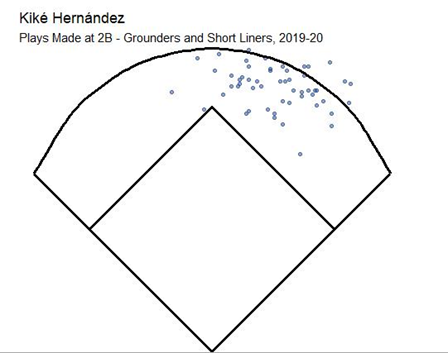
Hernández and Wong are arguably the two best defensive second basemen in baseball right now. Wong has won three straight Fielding Bible Awards there but Hernández could make a case that he’s better given that over the last two seasons he’s played nearly 800 fewer innings there than Wong, but only trails him in Runs Saved, 24-21.
Wong’s value is in his consistency. He’s reached a level of excellence in getting to ground balls that he’s maintained for three seasons.
Hernandez has enhanced value in a utility role. He has a positive Runs Saved total at each of the three outfield spots, as well as shortstop.
In each case, defense is extremely important to their overall value. Each posted an OPS below .700 last season, so their ability to field is a big part of what warrants their being in the lineup.
Jackie Bradley Jr. CF
Bradley had a bounceback season in 2020 both with his bat, where he cut back on how often he pulled the ball and added hits without sacrificing power, and in the field, where he saved 5 runs and tied Kevin Kiermaier for the lead among center fielders with 11 Good Fielding Plays (he had 3 Misplays & Errors to Kiermaier’s 8).
On his best day, Bradley is a top-end defensive center fielder who adds value with his bat and arm. He came out as average defensively in 2018 and 2019, so the key for him will be getting to balls (like the one below) and making great throws as he ages beyond his prime.
Earlier this month, reports came out about Kia Tigers left-handed ace Hyun-jong Yang (also spelled Hyeon-jong Yang) looking to make the jump to MLB this offseason. To most North American fans the 32-year-old Yang is likely someone they have never heard of, except for maybe catching a glimpse of him playing an early-morning KBO game on TV.
Season
W-L
ERA
K/9
BB/9
2017
20-6
3.44
7.4
2.1
2018
13-11
4.15
7.4
2.1
2019
16-8
2.29
7.9
1.6
2020
11-10
4.70
7.8
3.3
Background:
Hyun-jong Yang has had quite a successful career in the KBO since debuting for Kia in 2007 as a 19-year-old. In 2014 Yang was awarded the Dong-won Choi Award, the KBO equivalent of the Cy Young, going 16-8 with a 4.25 ERA (the KBO was in a high run-scoring environment at the time).
After the 2014 season Yang was posted by the Tigers in his first attempt to come to MLB. However, the bid received by the Kia Tigers was deemed by the club to be too low so they chose not to accept the bid and kept Yang.
The best year of Yang’s career was 2017, where he started the season pitching for the Korean national team in the World Baseball Classic. In the KBO that year Yang went 20-6 with a 3.44 ERA, winning his second Dong-won Choi award and the league MVP. The Tigers won the Korean Series and Yang was named Korean Series MVP to top off his dominant year.
How he Pitches:
Pitch Type
Percentage Use
Average Velocity (MPH)
Fastball
58%
89
Changeup
23%
81
Slider
15%
81
Curveball
5%
75
The bespectacled Yang has a simple and repeatable wind-up with a full leg kick and a release from a ¾ arm slot. Yang has a traditional pitch mix of a fastball, slider, curve and changeup. His fastball is a straight 4-seamer that averages just under 90 MPH and can touch 93-94. Yang makes up for the low velocity by being able to locate his fastball to all four corners of the zone and is comfortable working at the top of the zone or above the zone as well as inside to hitters.
Yang’s low 80s changeup is his best secondary pitch, and it plays off his fastball well. He gets quite a few bad swings and misses from hitters that are out in front of it. Yang’s control of his changeup was a bit of an issue early in the season, as he was either leaving it belt high or burying it in the dirt. As the season went, he was able to throw his changeup for low strikes more regularly but his command of the pitch can still be inconsistent.
His third pitch is a low 80s slider, which has sweeping movement along with some drop. Like his change up, Yang only throws his slider to one half of the plate (inside to righties, away to lefties).
Yang’s last pitch is his curveball, that he throws in the mid 70’s. It doesn’t have exceptional break, but he uses it more as a change-of-pace breaking ball or to steal a strike at the beginning of an at-bat.
Overall, Yang typically has good control and can locate certain pitches to certain parts of the zone. He appeared to be wary of giving up hard contact this season, and buried more pitches in the dirt as a result. This along with varying his pitch mix and occasionally relying on his 3rd and 4th pitches against certain teams may have contributed to his rising walk rate this season.
When he misses his spots, Yang also tends to miss away from the middle of the plate, which helps him avoid getting hit hard. While he throws his fastball well over 50% of the time, he does have the confidence to throw his change or slider multiple times in a row if he feels that pitch has a better chance to get a tough hitter out.
Overview:
Hyun-jong Yang appears to be a candidate to make it to MLB as a control-reliant lefty at the back end of a rotation, with fastball command and a good offspeed and breaking pitch to make up for the low velocity.
However, should he need to move to the bullpen he has the pitches to get both lefties and righties out (and if his fastball gained a few miles per hour in short stints that would help too).
It will be interesting to see what adjustments he makes in the MLB in terms of pitch locations and sequences, such as working on a backdoor slider to righty hitters or throwing more changeups to lefties. In fact, in his best start of the season (8 scoreless innings on October 18) he threw more changeups to left-handed hitters, although he also had his best fastball velocity of the season in that game too. MLB teams in need of lefthanded pitching depth should take a close look at Yang.
On this episode of the Sports Info Solutions Baseball podcast, Mark Simon (@MarkASimonSays) is joined by the godfather of baseball sabermetrics, Bill James (@billjamesonline) to discuss The 2021 Bill James Handbook.
Bill talks about the articles he wrote and the studies he did, including: Game Score for Batters, a companion stat to Bill’s popular Game Score for pitchers that is available on ESPN.com and Baseball-Reference (4:39); A look at Hall-of-Famers by team – which teams are most overrepresented in the Hall of Fame and which are most underrepresented (7:40); the Hall of Fame Monitor, which evaluates the likelihood of a player getting in the Hall of Fame (11:31), and Career Targets (also known as The Favorite Toy) which establishes the percentage chance a player has of reaching a milestone (13:44).
Bill also talks about an article he wrote for Bill James Online on the quality of MVP classes (15:53), shares a stat that he wished caught on more (19:36), and speaks about the all-around excellence of Mookie Betts (24:53).
Mark closes the show with an announcement of the winners of the 2020 Fielding Bible Awards (26:57).
Thank you for listening. You can buy The Bill James Handbook here. Please rate and review us if you can. Stay safe and stay well.