Category: Baseball

  • 2018 MLB mock draft

    From SPORTS INFO SOLUTIONS VIDEO SCOUTS
    Last week, Sports Info Solutions’ video scouts conducted a mock MLB Draft. Our video scouts regularly watch college baseball, so for each collegiate player, we offered a detailed assessment of his skills, with help from Baseball America, MLB Pipeline, Fangraphs and other resources.

    1. Detroit Tigers: Casey Mize, RHP, Auburn
    At 6’3″ and 220 pounds, Mize certainly looks the part of a front line starter for years to come in the majors. His arsenal presents three plus offerings, including a mid-90s fastball with good life, a splitter that dives at the plate, and a slider. The quality of his pitches is enough to intrigue scouts, but what really sets him apart is his command. In the last two college seasons, Mize boasts 249 strikeouts to only 19 walks in 186 1/3 innings pitched for Auburn.

    By Alex Cole

    2. San Francisco Giants: Matthew Liberatore, LHP, Mountain Ridge HS (Arizona)

    Since Madison Bumgarner was drafted in 2007, the Giants have failed to develop a top of the rotation arm. They’ll have a chance to draft someone viewed as having ace potential.

    By Ken Gaffney

    3. Philadelphia Phillies: Alec Bohm, 3B, Wichita State

    For the Phillies, the selection of Bohm makes perfect sense for a number of reasons. Bohm has plus power potential with future middle of the order consideration. His bat appears to play well with aluminum and wood given his success in the CPL and Cape Cod Summer League. His bat alone could give him a quick path up through the minors. Bohm will likely get work at both corner infield positions and could test his athleticism in left field as well. This would give the Phillies position versatility which, as they have proven this year, they covet. If the Phillies draft Bohm, he would instantly become their highest rated corner infield prospect.

    Scouts note that Bohm’s potential comparison lies somewhere between Pat Burrell and Kris Bryant, both of whom were former college third baseman drafted in the top 10. However, the best-fitting comp for Bohm is probably Troy Glaus.

    By Matt Noskow

    4. Chicago White Sox: Nick Madrigal, 2B, Oregon State

    Widely considered the top hitter in this year’s draft, Madrigal also has great speed and a plus glove. He also has great discipline at the plate, drawing 53 walks in his college career and only striking out 34 times. The biggest concern for Madrigal is his height (listed at 5’8″ 160 lbs), which explains his lack of power, but with players like Dustin Pedroia and Jose Altuve winning MVPs in the majors, a smaller player like Madrigal isn’t as big of a concern as it was a few years ago.

    By Kyle Price

    5. Cincinnati Reds: Brady Singer, RHP, Florida

    After dominating the Cape in 2016 and a strong season in 2017 (129/32 K/BB), Singer entered the college season considered by many to be the top available talent in the draft. His stock has taken a slight hit throughout the year but has risen back up as of late. With a plus fastball and slider the question has been the changeup and the ability to repeat his delivery. Catcher Joey Bart is an option here, but with the Reds’ recent inability to develop pitching they will try to get a polished college pitcher that they only have to mechanically tweak rather than build from the ground up with a raw prep (Cincinnati took Hunter Greene in 2017).

    By Josh Hofer

    6. New York Mets: Shane McClanahan, LHP, University of South Florida

    McClanahan, drafted once already by the Mets in 2015, boasts a fastball-changeup combination — the former of which can hit triple digits — that exhibits flashes of Chris Sale.

    Even with some command issues and a delivery that MLB Pipeline describes as having “a fairly big recoil,” McClanahan projects as a high-strikeout guy who could move up the minor league ranks quickly. Given his athleticism and pure stuff, an improved slider and refined command would grant him true ace potential. His best comparison could be Robbie Ray.

    By Harris Yudin

    7. San Diego Padres: Jarred Kelenic, OF, Waukesha HS (Wisconsin)

    The top prep bat in the 2018 class, Kelenic is said to be a prospect with a high floor and an exciting offensive profile, along with a 96 MPH arm.

    By Kenny Kirkpatrick

    8. Atlanta Braves: Joey Bart, C, Georgia Tech

    Though Bart is a taller catcher, his plus arm projects him to stay behind the dish long-term. Bart calls all of his pitchers’ games at GT which will obviously translate well to handling a staff at the next level.

    Bart’s plus power will play at the next level and is what has shot him up draft boards this spring. His biggest question mark remains to be his hit tool as he can become a player with high strikeout and low average numbers. If he can continue to grow as a hitter at the next level he can become a superstar at the catcher position. If not, he will still be a solid player behind the plate with his power and defensive ability.

    By Derek Tarconish

    9. Oakland Athletics: Logan Gilbert, RHP, Stetson

    While Gilbert might lack the electric upside of McClanahan and others, he presents less risk, providing a polished repertoire and track record of performance. Oakland would do well to go all-in on Gilbert’s rare combination of premium physicality and repeatable delivery. His extension and tempo project plus command, while he’s shown three to four pitches that can be impact Major League offerings.

    His fastball has downhill plane, benefiting from his release height and extension, playing a touch above its velocity. If the fastball ticks back up to the mid-90s range that it sat in last summer, Gilbert’s ceiling is as high as anyone’s. If it hovers in the low 90s as it has this spring, he still has the ability to profile as a workhorse No. 2 or No. 3 starter. Comp: Josh Beckett

    By Brett Bittiger

    10. Pittsburgh Pirates: Carter Stewart, RHP, Eau Gallie HS (Florida)

    Stewart is widely considered the best high school pitcher in the 2018 draft, with a 98 MPH fastball. Drafting Stewart will give Pirates fans a future rotation to dream about that includes RHP Mitch Keller, RHP Shane Baz, and RHP Carter Stewart.

    By Jimmy Burns

    11. Baltimore Orioles: Jonathan India, 3B, Florida

    A potential replacement for Manny Machado, India can be a fast mover through the minor league ranks to help the struggling major league squad. India broke out this year, with an OPS over 1.200. He has good plate discipline and athleticism with solid power and the ability to play second base or even shortstop in a pinch, though he looks to stick at 3B. His best comp may be Justin Turner.

    By Jonathan Simmons

    12. Toronto Blue Jays: Travis Swaggerty, OF, South Alabama

    The Blue Jays have been talking about getting younger and more athletic, and Swaggerty would be the type of player that could help them achieve that goal. Swaggerty has above average speed and a decent arm for center field, along with good strike zone knowledge and improving power from the left side. His best comp could be Brett Gardner.

    By Ted Baarda

    13. Miami Marlins: Kumar Rocker, RHP, North Oconee HS (Georgia)

    Following the Marlins’ trend from the last two years by going with a high school arm, Rocker throws a fastball that touches 98. If he doesn’t sign, he’s headed to Vanderbilt.

    By Josh Fellerman

    14. Seattle Mariners: Ryan Rolison, LHP, Ole Miss

    Rollison’s fastball sits in the low 90s but can get up to 95 at times. He has probably the best curveball in the draft but has struggled to develop a useful third pitch. He has a changeup that doesn’t have much movement and he has barely used it this year but if it develops into something he uses more frequently, he could have three plus pitches. He excelled in the Cape Cod League by mixing up his pitches to keep hitters off balance, but in this year in SEC play he has struggled to find his command at times. If he polishes up his command and develops that changeup, he could become a #2 starter.

    By Kerby Callison

    15. Texas Rangers: Will Banfield, C, Brookwood HS (Georgia)

    Committed to Vanderbilt but could sign if taken in the first round. He’s viewed as strong offensively with a lot of potential.

    By Adam Rielly

    16. Tampa Bay Rays: Connor Scott, OF, Plant HS (Florida)

    For the Rays Connor Scott is an easy pick. 6’4″ 180 lbs athletic outfielder from Plant HS which is located in Tampa. Scott can both play the field and pitch, but is projected as an outfielder.

    By Cole Seltzer

    17. Anaheim Angels: Nolan Gorman, 3B, Sandra Day O’Connor HS (Arizona)

    Gorman is said to have great power, with consistency at the field and approach at the plate being keys to his future success.

    By Mitch Glessner

    18. Kansas City Royals: Cole Winn, RHP, Orange Lutheran HS (California)

    Cole Winn is a prep righty who committed to Mississippi State. He’s said to have three really good pitches already.

    By Dominic Asta

    19. St. Louis Cardinals: Brice Turang, SS, Santiago HS (California)

    The Cardinals would be the perfect organization for Turang thanks to their strong reputation developing players, as he has all the tools but just needs to maximize each one.

    By Justin Stine

    20. Minnesota Twins: Ryan Weathers, LHP, Loretto HS (Tennessee)

    The Twins have used seven of their last nine first round picks on high schoolers and it continues here. Weathers is the son of former major league reliever David Weathers. He throws a bit harder than his dad – 97 MPH.

    By Evan Butler

    21. Milwaukee Brewers: Jackson Kowar, RHP, Florida

    Kowar possesses one of the better changeups in the draft to go along with a mid-90s fastball that can touch 98. Kowar was terrific as Florida’s number two behind Brady Singer, posting a 3.21 ERA in 92.2 innings. If he can develop his breaking ball into a better offering, he can move quickly through the minors.

    By Nick Rabasco

    22. Colorado Rockies: Cole Wilcox, RHP, Heritage HS (Georgia)

    Wilcox throws in the mid 90s and reportedly has a well-developed changeup.

    By Andrew Zenner

    23. New York Yankees: Ethan Hankins, Forsyth Central HS (Georgia)

    Hankins was an early front runner for the No.1 pick going into the year, but with a tough spring he has fallen a little bit. The Yankees, not being one to shy away from high profile players, will have to lure the high schooler (who peaks at 99 mph) away from his commitment to Vanderbilt.

    By Marc Roche

    24. Chicago Cubs: Blaine Knight, RHP, Arkansas

    Coming back for his junior season has brought Knight on the cusp of being a possible first round selection. Armed with a mid-90s fastball and a breaking ball with one of the highest spin rates in the draft, Knight fits the recent draft tendencies of the Cubs. Plucking pitching from the college ranks has been the Cubs M.O. and that should continue this draft year.

    By Nathan Phares

    25. Arizona Diamondbacks: Jake McCarthy, OF, Virginia

    In the 2017 MLB Draft, Mike Hazen spent 8 of his first 11 picks on college bats, with an emphasis on hitters who can draw walks and get on base at a high clip. McCarthy doesn’t totally fit the mold of those picks, but with a strong hit tool and plus speed McCarthy can certainly handle the rigors of a traditional top of the order presence. What will determine his ceiling as a prospect will be defense in center field. A polished college bat with a track record of wood bat performance (.387/.441/.613 in his nine CCBL games in 2017) is certainly a valuable commodity in the late 1st round.

    By Will Hoefer

    26. Boston Red Sox: Steele Walker, OF, Oklahoma

    The Red Sox are happy to take another first round college outfielder here in Steele Walker. The young lefty with plenty of raw power will look to use the Green Monster to his advantage in the future with his ability to hit line drives to all fields. Walker’s strong pitch recognition will also him to potentially develop his power as he matures. While he has been able to play all over the outfield for the Sooners, his arm strength likely slots him in left field where his plus baseball instincts will allow him to handle the Monster with ease.

    By Dan Kelly

    27. Washington Nationals: JT Ginn, RHP, Brandon HS (Mississippi)

    Washington’s farm system is skewed towards position-player prospects, so in the 2018 draft they’ll look to insert a little more balance by selecting a prep arm with the tools to excel as a starter or reliever.

    By Dylan Thomas

    28. Houston Astros: Tim Cate, LHP, Connecticut

    Cate has the best curveball in college and potentially the entire draft. It’s no secret the Astros are an analytics-forward organization and have really taken advantage of pitchers with high spin rates. Cate already has an above average spin rate on his curveball and with the development of a fourth pitch, Cate could fill in nicely at the back end of the rotation. Cate sits at 91-93 with his fastball but has had velocity issues the longer he pitched into games. This has made his 3.26 ERA look less than impressive but he is still generating over 11 K per 9 in his three years at UConn. This might be a little high for Cate to go in the draft but the Astros could really use a top lefty with the potential departure of Keuchel this winter.

    By Zak Sokoloski

    29. Cleveland Indians: Jordyn Adams, OF, Green Hope HS (North Carolina)

    Following the 2016 draft model, Cleveland is selecting an elite two-sport athlete with five-tool potential and buying them out of their college commitment.

    By Kevin Black

    30. Los Angeles Dodgers: Jeremy Eierman, SS, Missouri State

    Eierman burst on the scene as a sophomore by belting 23 homers and slugging .675. As a junior his numbers regressed back closer to his freshman year. Eierman’s rare power as a shortstop is what makes him a top draft prospect, and an improving glove gives scouts faith he can stay at short at the next level.

    He has shown consistent power and slugging at Missouri State with increasing abilities on the base paths and in the field. The improving glove and speed paired with an elite power bat for an infielder make Eierman a desirable early round prospect. MLB Comparison: With similar skill sets, size, and flaws Eierman fits the new mold of the “power shortstop” much like Paul DeJong of the St. Louis Cardinals.

    By Nicholas Solitario

  • Jeremy Hellickson’s start keyed by curveball

    Jeremy Hellickson’s start keyed by curveball

    BY SPENCER HARRISON
    Before Jeremy Hellickson made his 2010 debut with the Tampa Bay Rays, he was considered one of MLB’s most promising pitching prospects. Through his first two full seasons he looked every bit the part, stringing together consecutive seasons of 2.95 ERA and 3.10 ERA pitching in 2011 and 2012, albeit with some concerning peripheral stats.

    Then, in 2013, those peripherals caught up to him as his ERA ballooned to 5.17. Things have been mostly bumpy since then, with the exception of the 2016 season in which he pitched his way to a 3.71 ERA and a qualifying offer from the Phillies.

    Still, coming off a season in which he posted his worst K:BB ratio since 2011 and career worsts in ERA and home run rate, there was little reason to believe he would turn out to be more than a depth signing when the Nationals added him on a minor league deal in March.

    We’re now two months into the MLB season and Hellickson has flourished as the Nationals’ fifth starter. Through 43 innings, he has a 2.30 ERA, 5.7 K:BB ratio, and 0.93 WHIP. All of those marks would be career bests if sustained through the rest of the season. He has benefitted from some luck, but his 3.30 FIP indicates his early success is quite legitimate.

    So how has Hellickson bounced back from arguably the worst season of his career?

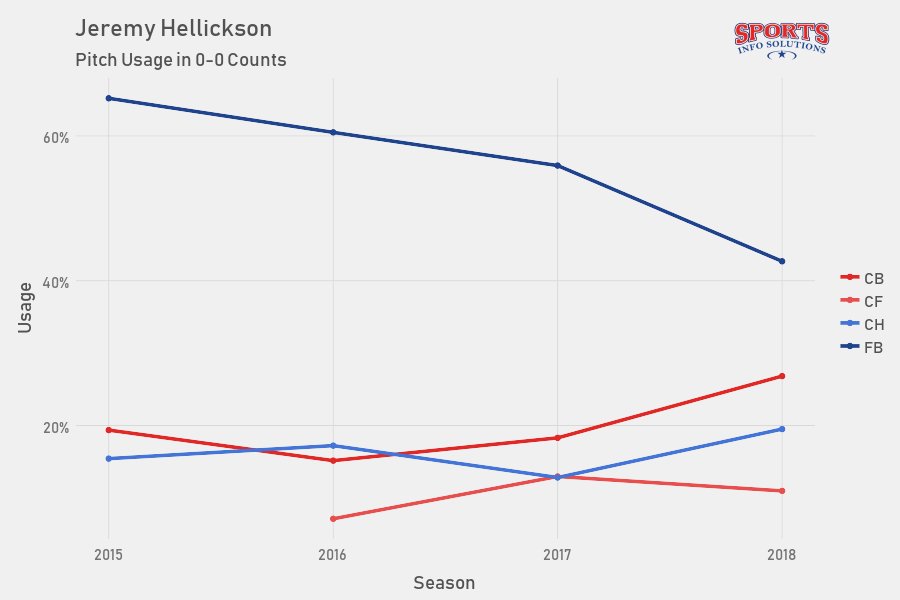
    His pitch usage this season offers some indication. His fastball usage has dipped from 46 percent in 2017 to 36 percent in 2018. Meanwhile his curveball usage has spiked to 27 percent, up from 13 percent in 2017. Compound that with a whiff rate on the pitch that is more in line with his career average (28 percent) then his 2017 season (15 percent) and things make a bit more sense.

    Yet Hellickson is pitching much better than his career average. What has really driven Hellickson’s success this season is first-pitch strikes.

    Among pitchers with at least 30 innings pitched, Hellickson’s 70 percent first-pitch strike rate ranks fourth in MLB. This is another area where increased curveball usage has been of importance for Hellickson.

    Hellickson has upped his first pitch curveball usage from 18 percent last season to 27 percent this season while his fastball usage is down to 43 percent from 56 percent in 2017. That change in strategy has paid dividends for Hellickson, who is converting 75 percent of his first-pitch curveballs into strikes (tied for second among MLB starters) and has a called strike rate of 67 percent (T-3rd in MLB) on the pitch.

    It makes sense that starting an at-bat with a strike is huge for a pitcher, but the numbers back this up. The MLB average wOBA allowed after a 1-0 count is .359. If the count starts 0-1 it drops to .268. That split holds true for Hellickson as well, who boasts a .249 wOBA against when starting an at-bat with a strike.

    One final point of emphasis for the Nationals with Hellickson pitching seems to be getting him out of the game before he faces the opposing lineup for a third time. He has gone over the 90 pitch mark just twice this season, and has had three starts end with fewer than 75 pitches.

    It makes sense given his splits this season. Opponents are 9-for-17 with five extra-base hits the third time through the order. While pitching the first two times through the order he holds opponents to a .228 wOBA (and only eight extra-base hits).

  • Kole Calhoun can’t beat the shift, but his glove is doing many good things

    Kole Calhoun can’t beat the shift, but his glove is doing many good things

    BY LINDSAY ZECK
    Angels right fielder Kole Calhoun has had one of the most unusual seasons of any player in 2018. His offensive performance has been well below his usual standards, but his defense is keeping him afloat.

    The hitting
    Of all the qualified batters in the game, Calhoun ranks last in batting average (.151) and last in OPS (.389).

    His main downfall has been his inability to beat the shift. He has been shifted at least partially on all but two of his groundball and short line drives this season.

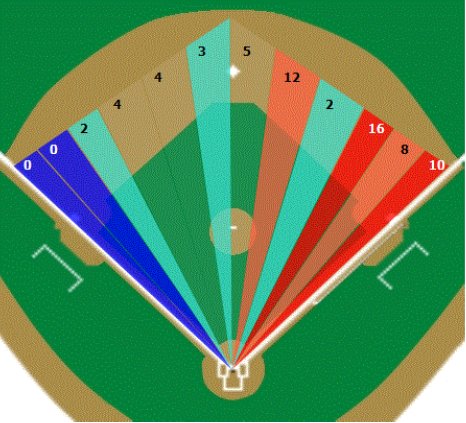
    As seen in the chart below, Calhoun has hit 80 percent of his grounders and short line drives to the right of second base — right into the gloves of his shifted opponents.

    Locations of Calhoun’s Groundballs and Line Drives, 2018

    See the first slice to the right of second base. Take that one and all of the ones to the right of it. Calhoun is a combined 4-for-53 on those balls this season. He’s not even close to the MLB average just on ground balls hit to the right of second base (.222).

    Calhoun is tied with Tigers DH Victor Martinez for the most net hits lost due to the shift this season with 11. Had these 11 hits got through the infield, his .151 batting average would increase to a more respectable .221.

    The defense
    Calhoun’s case to remain in the starting lineup, despite his slow start at the plate, lies with his great play so far in right field. He has already saved the Angels seven runs this season in 398 innings.

    This is more than he has ever saved his team and he still has just over two-thirds of the season left to play.

    His eight Good Fielding Plays in right field are tied for third-most in the league at the position, behind only Carlos Gomez and Stephen Piscotty. He also has yet to commit an error and has only three Defensive Misplays.

    Perhaps Calhoun’s biggest strength this season has been his arm:

    • He has four Outfield Arm Runs Saved—tied for second most in the league behind Aaron Judge (5).

    • Four of his eight Good Fielding Plays are due to his ability to throw out baserunners. One of which was this double play last week where Calhoun threw out Curtis Granderson at home plate.

    • He is tied with Lorenzo Cain, Aaron Judge, and Josh Reddick for the most Outfield Kills—an outfield assist without the use of a relay man — with five.

    • Baserunners are taking less chances with Calhoun this season. They have attempted to take an extra base on only 13 of 33 opportunities (39 percent) — in line with Calhoun’s career best in that department.

    Calhoun hasn’t been a stranger to the highlight reel either with plays like this catch against Marcus Semien in March or this one that robbed Gleyber Torres of an extra-base hit back in April.

    In order for Calhoun to be given the chance to keep succeeding in the field, however, he needs to perform better at the plate and figure out how to beat the shift—a .151 batting average may not cut it much longer.

  • A closer look at the Mets catching situation

    BY SEAN ZERILLO
    In 16 games with the New York Mets since being traded for Matt Harvey, Devin Mesoraco has provided a big power boost for his new club – hitting five homers with a .913 OPS over 50 at bats. He has channeled his 2014 All-Star form when he hit 25 doubles and 25 homers with a .893 OPS in 384 at bats with the Reds.

    The team will enter into a timeshare at catcher between Mesoraco and Kevin Plawecki, as the latter is back with the Mets after breaking his hand on April 11 and Travis D’arnaud is set to miss the rest of the season with a torn UCL.

    Comparing the defense
    Since his debut in 2015, Plawecki has 16 Defensive Runs Saved over 1,244 innings. He has saved his team 1.29 runs for every 100 innings played at catcher.

    Since his 2014 All-Star campaign, Mesoraco is -15 in Defensive Runs Saved over 1,604 innings. He has cost his team .935 runs for every 100 innings played at catcher.

    Much of the positive data for Plawecki is due to an outstanding rookie year behind the plate in 2015 and if he can return to that form, he’s probably the better option behind the plate. He had 10 Strike Zone Runs Saved and 5 Adjusted Earned Runs Saved (a stat that attempts to convey staff-handling — think of it as a better form of catcher ERA) over just 70 games and 602 innings, nabbing 87 more strike calls than expected, or about one in every 6.9 innings.

    Shared struggles
    That efficiency, however, has dropped off steadily since then to 2 Strike Zone Runs Saved in 2016 and -4 in 2017. Plawecki has cost the Mets 36 strikes in his last 37 games, instead of stealing more than one per game as he did in 2015. He does remain at 6 Adjusted Earned Runs Saved for his career.

    Mesoraco has never been particularly adept at maximizing called strikes. In that 2014 All-Star campaign, his only season with over 100 games played, Mesoraco finished with -7 Strike Zone Runs Saved. He has cost his team 8 Strike Zone Runs Saved in the 76 games he has played since 2016. He has cost his pitchers 23 strikes in the 24 games he has played in 2018. He’s also totaled -4 Adjusted Earned Runs Saved for his career.

    Pitch-blocking: Advantage Plawecki
    Mesoraco is also a liability at blocking potential wild pitches. Since the start of the 2016 season, he has blocked just 90 percent of potential wild pitches, a rate closer to Gary Sanchez (89 percent) than it is to Plawecki (93 percent) or 2017 Fielding Bible Award Winner Martin Maldonado (also 93 percent).

    Defensing bunts: Advantage Mesoraco
    The one area where Mesoraco has excelled defensively is in bunt defense. He has saved five runs defensively on bunt attempts for his career. Plawecki has not recorded a positive or negative value on bunt attempts, and remains at 0 Runs Saved for his career.

    SB an area of interest to Mets
    In recent seasons the Mets have consistently been one of the weakest teams at defending stolen base attempts, but Plawecki’s value on those steal attempts has been neutral (0 Stolen Base Runs saved for his career).

    Mesoraco has been below average at defending steals for his entire career, with a cumulative -11 Stolen Base Runs Saved. He is at -2 since 2016, and has thrown out only one runner in 19 attempts this season. Granted, pitchers are usually more responsible for stolen bases allowed than catchers, but Mesoraco’s long-term numbers indicate struggles in that area.

    Mesoraco hitting better than expected
    By our Defensive Independent Batting Stats (DIBS), Mesoraco’s Expected OPS this season is .704, far below his actual OPS of .787. This expected production is consistent with both his actual OPS (.711) and Expected OPS (.745) from 2017. They both are short of Plawecki’s actual (.764) and Expected OPS (.848) numbers from 2017 — the best offensive numbers of Plawecki’s career. So Mesoraco has been better in the short term, but the long term remains an unknown for both.

    But with Mesoraco’s strong offensive start, Plawecki may need to return to his 2015 defensive form to play his way back into a regular role.

  • Which infielders are best at making the toss-up plays?

    BY HARRIS YUDIN

    Since the start of the 2017 season, 325 infielders have been the primary fielder on a ball in play with a Sports Info Solutions Defensive Difficulty rating of 3 (1-5 scale). In this piece, we will identify the best and worst at each infield position at converting such plays.

    A play with a 3 difficulty is nearly a 50/50 play— one that can go either way (the actual conversion rate is around 55 percent). Seldom is a Defensive Misplay assigned to a toss-up play, and Good Fielding Plays are more commonly associated with a difficulty rating of 4.

    While it is challenging to near impossible to eliminate all human error, the video scouts at Sports Info Solutions aim to inject as much objectivity into the process as possible. For example, Nolan Arenado is going to make a difficult play look more makable than will Jake Lamb. The goal is to assign the proper difficulty rating by envisioning a league-average defender attempting to make each play.

    In order to qualify here, a player must have at least 200 plays as the primary fielder since the start of last season. All data runs from Opening Day 2017 through May 25.

    First Base
    Joe Mauer, Minnesota Twins
    Mauer’s success rate on these plays is a whopping 84 percent, helped by his being more successful on diving attempts than any other current first baseman, turning 23 of his 57 opportunities into outs (40 percent).

    Mauer excels moving to both the left and right, often taking away potential extra base hits down the line. While he may not be particularly flashy, the 35-year-old Mauer is making enough plays for the Twins to put off moving him to DH full-time.

    Josh Bell, Pittsburgh Pirates
    On the other end of the spectrum, Bell is currently bringing up the rear as one of two first baseman with a conversion rate below 40 percent (37 percent … just worse than Justin Bour’s 39 percent)—which is unfortunate considering, of the group, he has had the second-most such balls hit in his direction (38).

    Bell is extremely vulnerable to balls hit down the first base line, with just a 31 percent success rate on plays to the right. The Pirates’ cleanup hitter owns the worst Good Fielding Play–Defensive Misplay ratio at the position, so it makes sense that he fails to convert some of the tougher plays.

    Second Base
    Javier Báez, Chicago Cubs
    Baez, the 2017 multi-position Fielding Bible Award winner, has had his most success at second base, where he’s converted 19 of the 24 plays that were considered toss-ups (79 percent).

    He’s the best at the position going back on ground balls, with a 56 percent success rate on plays that require him to break away from the plate. Baez has also fared better when sprinting than any other qualified second baseman, and perhaps most impressively, he has turned a solid 82 percent of forehanded plays into outs (which ranks among the highest for any second baseman). Baez is much more than just a quick tagger; he has great range and picks up almost any ball hit in his vicinity.

    Daniel Murphy, Washington Nationals
    The eye test tells you that Murphy is well below average defensively. The metrics (-15 Defensive Runs Saved in 2017) agree. And our Defensive Difficulty data? More of the same. The 33-year-old owns a success rate of 41 percent on these plays , the lowest among second basemen.

    He has trouble with balls hit up the middle (26 percent moving to the left) and has recorded an out on just one of his 22 diving plays (5 percent). Murphy has yet to play this season, but his body of work from last year is large enough—and concerning enough—to earn him a spot on this list.

    Third Base
    Justin Turner, Los Angeles Dodgers
    While Nolan Arenado blows every other infielder out of the water when it comes to Good Fielding Plays, he has had many more opportunities than all other third basemen. Arenado leads the way in 4-difficulty success rate, but sits fifth in the 3-difficulty category, behind Turner, (71 percent) Eugenio Suárez (71 percent), Adrián Beltré (70 percent) and Kyle Seager (70 percent).

    Turner makes a living on weakly-hit balls—his 62 percent success charging in, 54 percent on sprinting plays, and 73 percent throwing on the move are all among the leaders at the position. Watching Turner man the hot corner is less of a spectacle than watching Arenado or Matt Chapman, but the Dodgers’ No. 3 hitter is as clean defensively as you will find.

    Todd Frazier, New York Mets
    By most advanced metrics, Frazier is one of the better defensive third basemen in baseball (fourth in Defensive Runs Saved, second in Defensive Runs Above Average last year).

    So why has he fared so poorly on these plays (43 percent)? Most of his struggles have to do with positioning—specifically his guarding the line—as he owns just a 28 percent success rate moving to the left and a 59 percent rate on backhanded plays.

    The eight-year veteran has the fourth-worst Good Fielding Play–Defensive Misplay differential among third basemen, with 10 of his 45 Defensive Misplays coming on ground balls hit down the line. Nicholas Castellanos is actually lower on the list at 40 percent success on toss-ups, but he has become a full-time outfielder this season.

    Shortstop
    Trevor Story, Colorado Rockies
    We’re going to change things up and go with the leader in ‘Grade 3’ play conversions rather than success rate, because though the differential is slim at the top, Trevor Story has a notable edge in successful conversions over Carlos Correa and Miguel Rojas.

    Story ranked fourth in Defensive Runs Saved last season. The 25-year-old can be mistake-prone, with the fourth-most Defensive Misplays at the position, but he has also accumulated the most Good Fielding Plays, more than half of which have come on ground balls hit in his direction

    Story has thrown on the move 183 times—by far the most in baseball—converting on such plays at a 75 percent clip. This skill has helped him record an out on 43 of the 63 such plays for which he was responsible.

    Marcus Semien, Oakland Athletics
    Semien isn’t just the worst shortstop at cashing in on toss-up plays—at 26 percent, he’s the worst infielder by a fair margin. He has made just 29 percent of his sprinting plays. Only Travis Shaw has converted a lower rate such plays in this stretch.

    Semien was actually 16th out of 59 shortstops in sprint speed last season, so it isn’t as if he can’t reach balls hit up the middle or in the hole. He doesn’t have the skills to cash in on these borderline opportunities. He doesn’t make a ton of mistakes, but his 11 Good Fielding Plays are the 38th most at the position.

  • How much has Kyle Schwarber improved on defense?

    BY MARK SIMON
    Kyle Schwarber had a rough re-acclimation to left field for the Chicago Cubs last year. He finished 2017 costing his team 9 runs defensively, which ranked fourth-worst among all left fielders. But in 2018, after a rough Opening Day, he’s flipped the script. His 5 Defensive Runs Saved rank fourth best at the position.

    The story behind Schwarber’s improved numbers is twofold.

    A more careful defender
    For one, he hasn’t done the things that hurt him the most. Last season, our video tracking charged Schwarber with 29 Defensive Misplays & Errors in left field (Misplays being things that had a negative consequence, such as allowing a baserunner to reach or missing the opportunity for an out). That was a rate of one every 28 innings.

    This season, Schwarber has made only 3 Misplays & Errors, a rate of one every 94 innings. If he was playing at last season’s rate, you’d expect that he’d have 10 Misplays & Errors by now.

    One of the biggest issues for Schwarber last season was in his handling of the ball – he had seven misplays for mishandling the ball after a safe hit or after a catch.

    Don’t run on this guy
    The other key change has been in his arm rating. Schwarber has four assists that didn’t require a cutoff man, tied for most among leftfielders, all of which have come this month. Among the highlights was his throwing out Nicky DelMonico at the plate, which netted a big smile as he ran back to the dugout, and the combination of a sliding stop and strong throw to nail Francisco Lindor, who was trying to stretch a single into a double.

    Throwing accuracy has thus far been good for Schwarber, who had 6 Misplays in arm-related categories (Missing the Cutoff Man and Wasted Throw After Hit or Error and Bad Throw to the Plate), but has none this season.

    Those four assists are already one more than Schwarber had all of last season. As such, only four baserunners have taken an extra base (first to third or second to home on a single, first to home on a double) against him on the 18 base hits he’s fielded.

    A 22 percent advance rate (lowest among all outfielders) with four unaided assists is worth four Defensive Runs Saved by itself. A 35 percent advance rate against Schwarber and three unaided assists were valued at -1 Defensive Runs Saved last season.

    Early returns: positive
    Though Schwarber doesn’t have a highlight reel of catches akin to some of his peers, he doesn’t need to have one to be successful. If he can take care of avoiding mistakes, his range and positioning ratings should stay steadily average.

    And so long as he doesn’t fall back into old habits, word will likely get out about his arm.

    In other words, if his defensive improvements match his offensive ones consistently, the Cubs should be in good shape in left field.

  • When Pedroia returns: Much better than Núñez, but keep an eye on the sliding

    BY NICK RABASCO
    This past offseason, the Red Sox re-signed infielder Eduardo Núñez with the knowledge that Dustin Pedroia would need a couple months to rehab his knee injury before getting back on the field.

    Nunez has been playing second base on a regular basis for Boston in 2018. Pedroia has been playing for the Pawtucket Red Sox the last few days and is nearing a return to Fenway Park.

    The differential
    The Red Sox are looking forward to having Pedroia’s defense back at second in a big way, because the difference between him and Nunez is huge.

    Sports Info Solutions has a video-tracking system for players, in which we award Good Fielding Plays in 30 categories (think: Web Gems) Defensive Misplays & Errors (mistakes such as slipping, colliding, failing to complete a double play) in 60 categories. According to that data, Pedroia has had a positive Good Fielding Play to Defensive Misplay plus Error ratio in every season since 2007. In fact, he had a 2-to-1 ratio in every season since 2007, except 2015 and 2017.

    Since 2007, Pedroia has been credited with 606 Good Fielding Plays and 228 Misplays & Errors. The ratio of his Good Plays to Misplays & Errors is the best in the majors in that time.

    In the last two seasons, Núñez has a Good Play to Misplay ratio of 2-to-23, the worst in the majors. Núñez is making mistakes more often than Pedroia and turning tough plays into outs or saving bases less often than Pedroia.

    Defensive misplays are divided into categories, and therefore we can get more granular with specific issues that Nunez has had.

    So far this season, Nunez has already been charged with two “Infielder Fails to Catch a Line Drive” misplays. These are plays in which a catchable line drive was hit his way, but he was unable to turn the play into an out despite getting a glove on the ball. For comparison, Pedroia has four such misplays in the past 10 years.

    Watch Pedroia slide
    It’s obvious that Pedroia will provide a significant upgrade over Nunez, but Pedroia is 34 years old and coming off knee surgery. So what can the Red Sox and their fans expect to see moving forward?

    After a terrific defensive 2016, Pedroia rated below average in 2017 with -2 defensive runs saved. Last year was also the first season Pedroia finished with a negative range and positioning total. That was driven by a lessened success on balls hit in the first base-second base hole.

    “You’re going to see the same guy you’ve seen play for however many years I’ve played”
    — Pedroia to reporters during hs rehab stint

    What should we be watching when Pedroia comes back? Pedroia is known as a player who goes all-out and is willing to dive or slide to increase his range whenever it’s necessary to make a play.

    From 2013 to 2016, Pedroia was successful on 76 percent of the plays in which he had to slide to field a ball. In 2017, he was successful on 4-of-11 sliding attempts, which comes out to half as often as he did in the previous four seasons.

    That could be random based on a small sample, but could also be indicative that the Red Sox have to make sure they put Pedroia in the best possible position to be effective as he gets older.

  • Why not shift José Altuve?

    Why not shift José Altuve?

    By ANDREW ZENNER
    I was looking through our data to determine whether there were any hitters that may be strong “shift candidates” that are shifted against infrequently.

    One name stood out in my findings: Houston Astros second baseman Jose Altuve. Let’s look at whether other elements of our data support the lack of shifting for him.

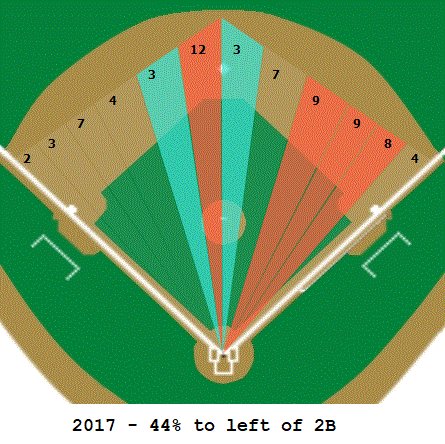
    Looking at the proportion of grounders and short liners that Altuve has hit to the left of second base, he appears to be a strong shift candidate.

    88 percent of those balls in 2018 have been to the pull side. That number falls to 83 percent since the start of 2015, but that’s still fairly significant.

    For context, Mets outfielder Yoenis Céspedes is also at 83 percent since 2015. Yet Altuve has seen a team employ a shift against him only 9 percent of the time so far in 2018 and just 5 percent of the time since 2015. Cespedes has been shifted 36 percent of the time in that period.

    So why doesn’t Altuve see more shifts? Part of it may have to do with his success against the shift.

    Altuve has hit .325 on his grounders and short liners with no shift and .444 against the shift (24-for-54) since the start of 2015. That success is in such a small sample, though, that it’s unlikely to have scared many teams off in a meaningful way.

    The other thought has to do with where Altuve hits the ball when he hits it to the opposite field.

    Here is an image of Altuve’s grounders and liners by location since 2015.

    What I’d like you to notice is the second zone to the right of second base. It’s not a particularly hot zone, but it happens to be right about where a 2B would be positioned in a roughly “normal” alignment.

    Perhaps teams have taken notice of this and simply decided to keep their second baseman there rather than moving him. That seems like a perfectly viable strategy, but let’s look at the same graph for Cespedes to again provide context.

    These graphs look awfully similar. Cespedes has that same lukewarm zone to the right of second base that Altuve has. It represents 6 percent of the total for both of them.

    But teams have certainly had no problem shifting with Cespedes at the plate, especially relative to Altuve.

    Some would speculate that speed might also be a factor. Let’s look at another right-handed hitter with similar speed to Altuve. Altuve has averaged 28.4 feet per second per Statcast’s average sprint speed metric. Andrew McCutchen checks in slightly higher at 28.7 feet per second. McCutchen has hit 92 percent of his grounders and short liners to the left of second base in 2018, but he’s also been shifted much more often (40 percent of the time).

    So what are we left with? It’s pretty clear that Altuve and Cespedes have been very similar on grounders and short liners over the past three-plus seasons. I compared Altuve with McCutchen to address the speed component, but McCutchen doesn’t quite have any meaningful zone to the right of 2B like Altuve and Cespedes do.

    Perhaps it’s the combination of speed, success (in a small sample), and Altuve’s overall reputation as a well-rounded hitter that has kept teams from shifting against him. Based on the information presented here, it may be wise for teams to take a longer look at employing some shifts against Altuve.

    It seems that teams have at least taken notice a little bit so far in 2018: his shift percentage is up to 9 percent from 5 percent last year. If he continues to hit grounders and short liners to the left of second base as frequently as he has so far this year, expect that number to continue to rise.

  • Appreciating a .134-hitting catcher – for great defense

    Appreciating a .134-hitting catcher – for great defense

    By LINDSAY ZECK

    Rockies catcher Tony Wolters is hitting .134 so far this season—third worst of all catchers with at least 50 plate appearances, ahead of only Alex Avila and Roberto Pérez.

    So why haven’t the Rockies sent him down to the minors and brought up the hot-hitting Tom Murphy from Albuquerque? Murphy is currently hitting .301 with 11 home runs with the Triple-A Isotopes this season, in only 34 games.

    The answer is in the defensive value the Rockies see in a catcher who is not even hitting three quarters of his weight. Wolters’ defense has been outstanding so far this season. He is currently leading all catchers with eight runs saved—two more than anyone else at the position—and is only one behind the leader for the entire league, Brewers shortstop Orlando Arcia. This is new for the Rockies, as their catchers of the past haven’t exactly been skilled defensively.

    Here is a table showing the number of runs the Rockies’ primary catchers have cost the team going back to 2012:

    Season Primary Catcher Defensive Runs Saved Rank
    2018 Chris Iannetta -5 33
    2017 Tony Wolters/Jonathan Lucroy -1/-15 20/35
    2016 Nick Hundley -16 35
    2015 Nick Hundley -11 32
    2014 Wilin Rosario -14 31
    2013 Wilin Rosario -13 31
    2012 Wilin Rosario -18 33

    We can see that in 2016, Nick Hundley cost the Rockies 16 runs—more than any other catcher cost his team. In 2017, Jonathan Lucroy cost a combined league-worst 15 runs—seven for the Rockies after being traded at the end of July, and eight for the Rangers. Prior to the trade, the Rockies catchers (Tony Wolters—who cost the team a run, Ryan Hanigan, Dustin Garneau, and Tom Murphy) combined to cost the team six runs.

    So far this season, Chris Iannetta is tied as the second-worst defensive catcher, already costing the Rockies five runs.

    As a rookie, Wolters saved the Rockies five runs in 2016 while both filling in for an injured Nick Hundley and serving as his backup. He was the first Rockies’ catcher with positive runs saved since Yorvit Torrealba saved the Rockies one run back in 2013.

    This season, Wolters is the only catcher in the league to have saved runs in all five defensive components of Defensive Runs Saved for catchers—Stolen Bases, Bunts, Good Fielding Plays and Defensive Misplays Plus Errors, Adjusted Earned Runs Saved, and Strike Zone.

    Three of Wolters’ eight runs saved are due to his pitch framing—tied for the most in the league. He has currently obtained the second-most extra strikes called in the league with 21, behind only Yan Gomes with 23. Iannetta has zero extra strikes called this season and has been inconsistent in this stat throughout his career.

    The images below show the percentage of called strikes Wolters received by location along with the overall league percentage.

    Wolters Called Strike Rate, 2018

    Overall League Called Strike Rate, 2018

    We can see that against left-handed batters, when compared to the league, Wolters excels at receiving strike calls when the ball is low in the zone. Against right-handed batters, he is much better than the league at receiving called strikes high in the zone.

    Wolters, however, doesn’t only excel at pitch framing. Here are a few more facts about his defense:

    Pitchers Perform Better when he is Catching — The combined ERA of Rockies pitchers with Wolters behind the plate is 3.89. When Iannetta is catching, their ERA is 4.85.

    He limits stolen bases — Wolters has thrown out base-stealers in 6-of-17 opportunities (35 percent), right in line with his 37 percent last season. The overall league percentage for catchers is 21 percent.

    He can field a bunt — Wolters is one of only four catchers with a run saved due to bunt defense this season (our bunt runs saved rewards fielders who limit hits and cut down baserunners).

    He blocks – Wolters ranks 13th out of 48 catchers in pitch block rate (nearly 95 percent). He’s five percentage points better than Iannetta.

    The question the Rockies need to ask is, does the value of Wolters’ terrific defense significantly outweigh his shortcomings as a hitter? That they’re keeping him in the major leagues may tell you the answer to that.
    2018 Colorado Rockies Photo Day

  • Johan Camargo’s improvements net him everyday role

    Johan Camargo’s improvements net him everyday role

    By WILL HOEFER
    Braves’ Executive Vice President and General Manager Alex Anthopoulos called somewhat of a harried press conference on Sunday morning, in which he informed the media present at SunTrust Park that Jose Bautista had been released. The impetus for that decision, Anthopoulos noted, was to give Johan Camargo the everyday job at third base.

    There’s reason to be skeptical that this decision will last even through this season; it’s been the belief of this new Braves regime to not have anyone that could possibly block the arrival of slugging third base prospect Austin Riley.

    Nevertheless, a regular starting gig for any length of time has been a long time coming for Camargo. Widely viewed as a player with the ceiling of a utilityman, Camargo has exceeded expectations ever since his call-up in the summer of 2017. However, it’s not his slick fielding that’s inspired faith with the Braves’ front office, but the strides he has made at the plate.

    Camargo has improved his plate discipline dramatically by simply shrinking his zone. He’s swung at 22 percent of pitches outside the strike zone in 2018, down from a 34 percent clip in 2017. This has played a large part in Camargo cutting down on his whiffs; he’s gone from an 11 percent swinging strike rate last season to an 8 percent swinging strike rate this season.

    These improvements have already manifested in his walking more times in 81 plate appearances (15) than he did in 256 plate appearances last season (12). However, in addition to swinging at fewer pitches out of the zone, he’s cut his misses on those pitches (78 percent out of zone contact in 2018, 67 percent in 2017).

    Camargo probably won’t continue to maintain a Votto-eqsue 18 percent walk rate, but his improvements in discipline and contact show reason to expect some regression coming.

    That’s only part of the story with Johan so far. While perhaps not a swing-changer yet, Camargo has shown improvements in quality of contact so far.

    Last year, with pedestrian exit velocities and hard contact, it was probably in Johan’s best interest to focus on a more line drive heavy approach. This year has been different in a variety of positive ways. Camargo has gone from a 29 percent hard hit rate when making contact in 2017 to a 51 percent rate.

    He’s increased his flyball and line drive exit velocity from 91.4 MPH to 93.2 MPH, and has in turn started hitting the ball in the air more (6 point increase in fly ball percentage, 1.7 degree increase in avg. launch angle) with less bad contact (4 percent infield fly rate).

    There’s still room for improvement in terms of quality contact, however. Camargo still has issues barreling the ball (sub-5 percent barrel rate in both 2017 and 2018), which does provide somewhat of a bound on his expected productivity. But even those bounds aren’t prohibitive of great offensive performance.

    Camargo has an expected OPS of .881 so far in 2018. Camargo may only be hitting .215, but a quick search found three Web Gem-like plays against him in a four-game span by Evan Longoria, Denard Span and Carlos Gomez. Turn those outs into hits and Camargo’s batting average jumps 50 points.

    These figures of expected and actual offensive performance fit at pretty much any position on the field, with third base being no exception. Camargo has always been well-regarded as an infield defender, and there’s certainly an expectation in Atlanta that he continues to be a good defender at third base to ensure his status as an everyday starter.

    These offensive strides are coming in a small sample of only 81 plate appearances. But it is very clear that his bat has made a believer out of the Braves’ front office. It’s not every day that a general manager gathers the media to inform them of a new starter in the lineup.